Why Couples Need a Shared Debt Tracker: Pay Off Debt Together with Partner Mode
Money is the #1 cause of relationship stress. Payoff's Partner Mode gives couples a shared debt hub with split tracking, real-time messaging, and a shared AI coach - so you can pay off debt together without the arguments.
Money fights are the #1 relationship killer
Let's start with the uncomfortable truth that every couple knows but rarely talks about openly.
64% of couples say money causes the most stress in their relationship, more than parenting, household chores, or work-life balance combined.
If you and your partner have ever had a tense conversation about bills, spending habits, or who's paying what, you're in the overwhelming majority. Financial disagreements are the top predictor of divorce across every income bracket, every age group, and every relationship length.
And when you add shared debt to the equation, the tension multiplies. Suddenly it's not just "we disagree about money." It's "we owe money together, and we can't agree on how to deal with it."
Credit cards with both names on them. A car loan you co-signed. Student debt that one partner brought into the relationship. A personal loan you took out together for home repairs. Each one is a potential source of resentment, blame, and late-night arguments.
The problem isn't that couples are bad with money. The problem is that couples have never had good tools for managing debt together.
Why spreadsheets and separate apps fail
Most couples dealing with shared debt end up in one of three situations, and none of them work well.
The spreadsheet approach
One partner creates a detailed spreadsheet tracking every debt, payment, and balance. It works for about two weeks. Then one person forgets to update it. The other person doesn't check it. The numbers go stale. And the spreadsheet becomes another source of guilt rather than a tool for progress.
Spreadsheets also create an unhealthy dynamic where one person becomes the "financial manager" and the other becomes passive. This breeds resentment on both sides.
The separate apps approach
Each person downloads their own debt tracking app and manages "their" portion independently. This creates information silos. Partner A doesn't know if Partner B made their payment this month. Nobody has a clear picture of total household progress. And there's no shared accountability.
The "one person handles everything" approach
In many households, one partner takes full control of the finances. The other partner has no visibility into balances, payments, or progress. This might reduce day-to-day friction, but it builds long-term problems: the uninvolved partner feels powerless, the managing partner feels burdened, and if anything happens to the managing partner, the other is completely lost.
Introducing Partner Mode: a shared debt hub built for couples
Payoff's Partner Mode is one of the first dedicated shared debt tracking features in any debt payoff app. It's not a workaround or an afterthought. It's a purpose-built shared hub where both partners can see, track, and communicate about their debt in real time.
Here's what it looks like:
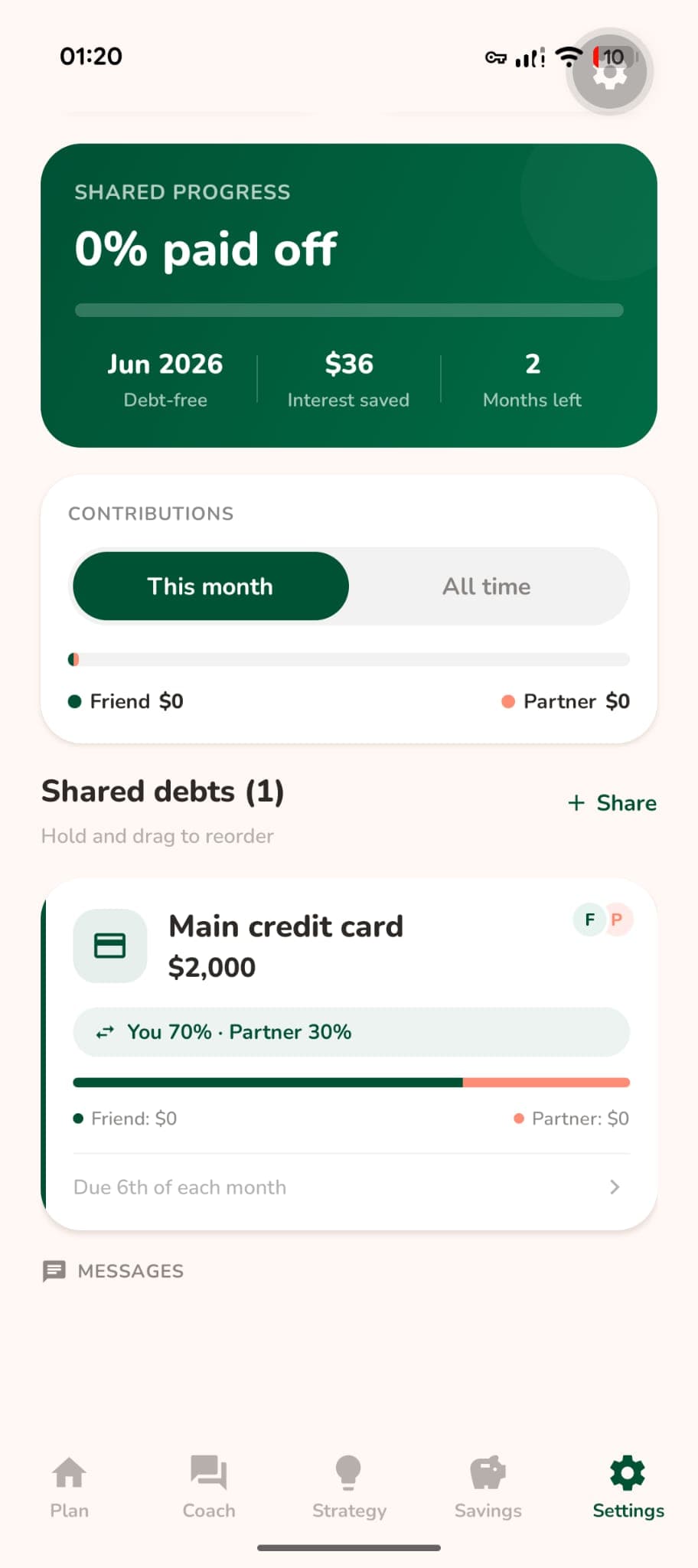
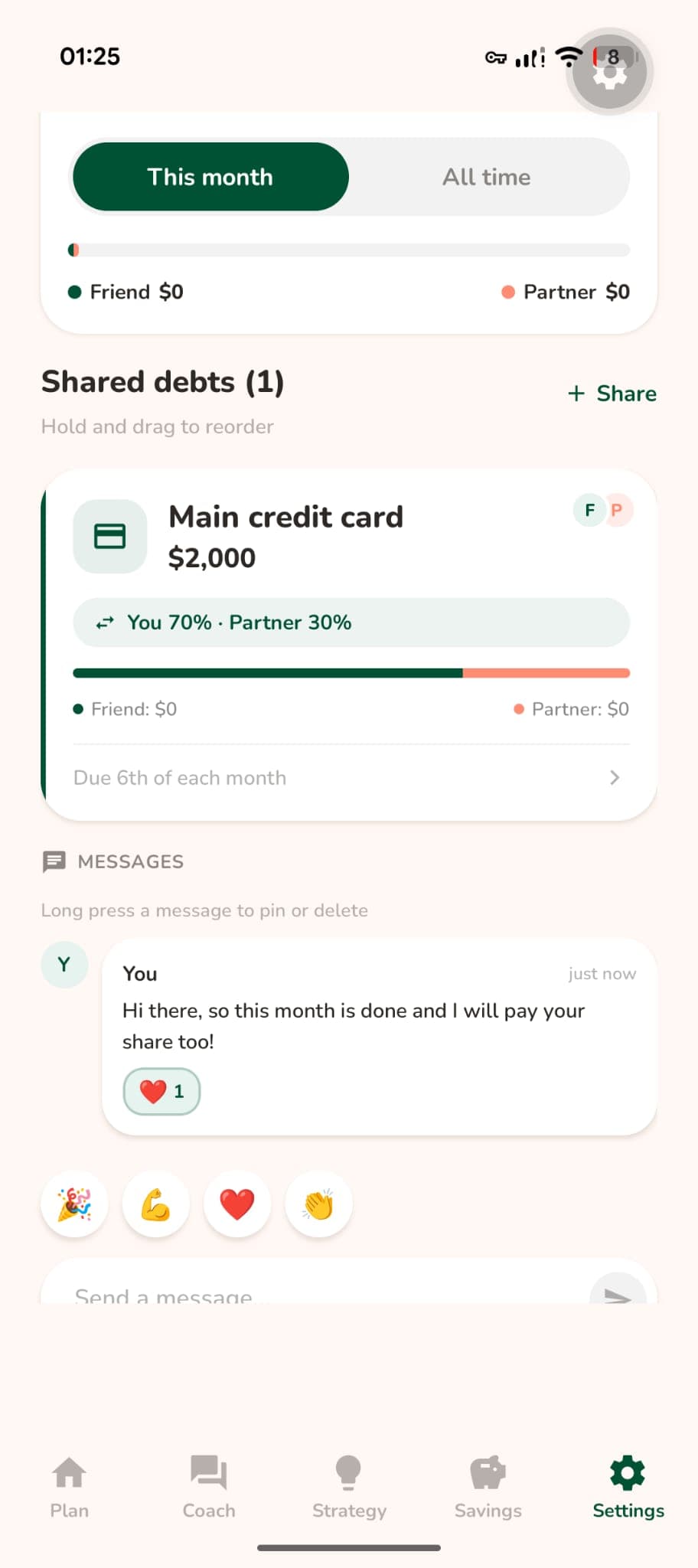
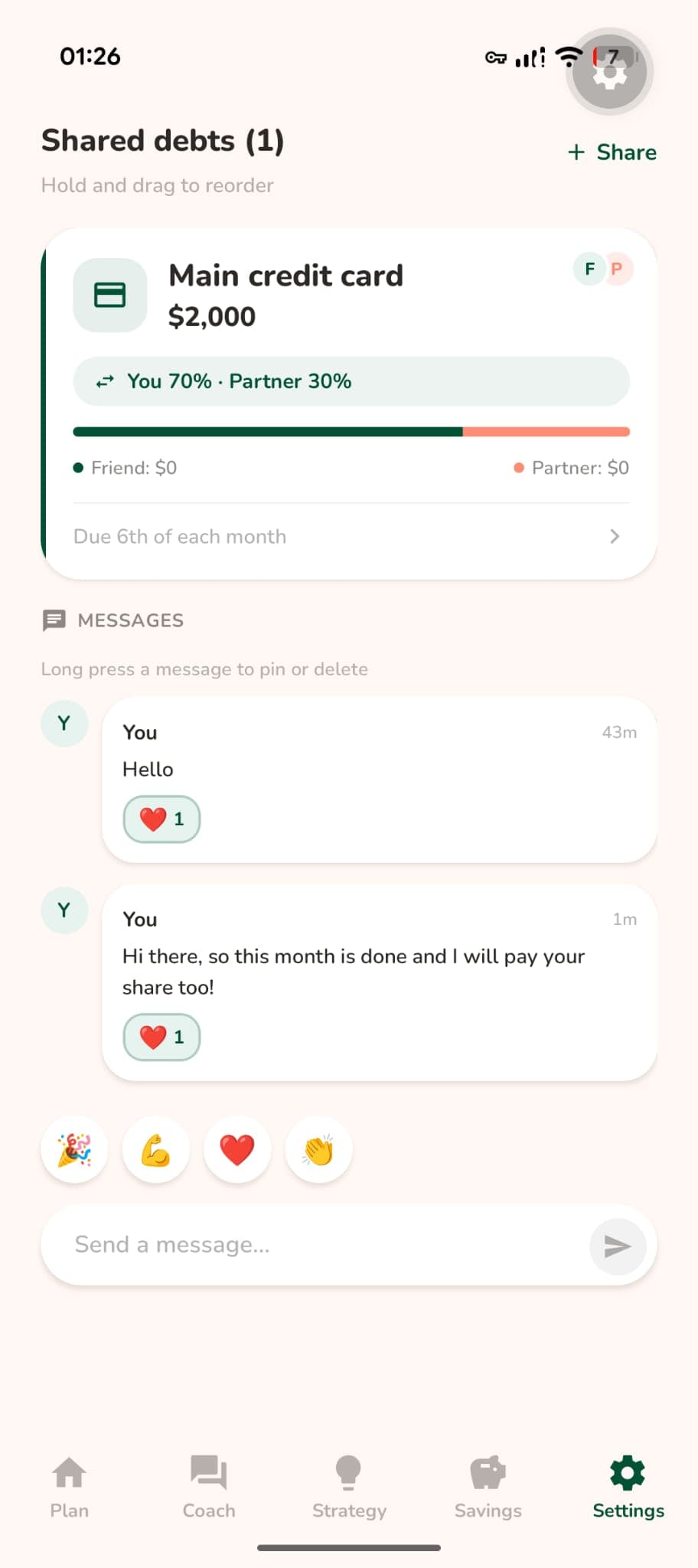
The shared dashboard shows your combined debt-free date, total interest saved, and months remaining. Below that, each shared debt displays both partners' contributions, split percentages, and a messaging thread for that specific debt.
No more guessing. No more "did you pay the Visa this month?" texts. Everything is visible to both partners in one place.
How Partner Mode works
Flexible split percentages
Not every shared debt is a 50/50 split, and Partner Mode doesn't assume it is. When you share a debt with your partner, you set the split percentage based on your agreement.
The 70/30 credit card split
Alex and Morgan have a $4,200 credit card balance that they both contributed to. Alex earns more, so they agree on a 70/30 split.
In Partner Mode, the debt card shows:
- Alex's responsibility: $2,940 (70%)
- Morgan's responsibility: $1,260 (30%)
- Alex's monthly payment: $245
- Morgan's monthly payment: $105
- Combined monthly payment: $350
When Alex logs a $245 payment, Morgan sees it instantly. The progress bar updates for both of them. Neither person has to ask "did you pay?" because the answer is always visible.
You can set any split from 0/100 to 100/0. Some couples split everything 50/50. Others divide based on income ratios. Some assign entire debts to one partner while sharing others. Partner Mode handles all of these arrangements.
Real-time payment tracking
When either partner logs a payment, the other partner sees it immediately. No waiting for bank statements to reconcile. No awkward "checking in" messages. The shared dashboard updates in real time, so both partners always have the same picture of where things stand.
This transparency is transformative for couples who have been arguing about money. When both people can see the same numbers at the same time, there's nothing to argue about. The data is right there.
Built-in messaging with emoji reactions
This is one of the features that makes Partner Mode genuinely different from anything else available. Each shared debt has its own messaging thread where you and your partner can communicate directly about that specific debt.
Made a payment? Drop a message: "Just paid the Visa! $350 closer to freedom." Your partner can react with a celebration emoji.
Found an extra $50 in the budget this month? Send a message asking if you should throw it at the credit card or the car loan. Discuss it right there, attached to the relevant debt.
This might seem like a small feature, but it solves a real problem. Money conversations are awkward. They're even more awkward over regular text messages, where tone gets lost and topics get mixed together. Having a dedicated space for debt-related communication, attached to the specific debt you're discussing, removes a huge amount of friction.
Shared AI coach
Most AI financial tools give advice based on one person's situation. Payoff's shared AI coach sees your combined debt picture and gives advice that accounts for both partners.
Ask it "should we focus on the credit card or the car loan first?" and it considers both partners' contributions, the interest rates, and your combined budget to give a recommendation that works for your household, not just one individual.
The shared coach also acts as a neutral third party. Instead of one partner telling the other what they think the strategy should be, you can both ask the AI and discuss its recommendation together. It takes the "you vs. me" dynamic out of financial planning and replaces it with "us vs. the debt."
A real couple, a real plan
Meet Jamie and Taylor: $15,000 in combined debt
Jamie and Taylor have been together for three years. Between them, they have $15,000 in debt across three accounts:
| Debt | Balance | APR | Whose name? |
|---|---|---|---|
| Chase Visa | $6,500 | 22.9% | Joint |
| Best Buy Card | $2,200 | 26.99% | Jamie's |
| Car Loan | $6,300 | 5.9% | Taylor's |
The Best Buy card is technically Jamie's, but they bought furniture together. The car loan is Taylor's, but Jamie uses the car too. The Chase Visa has both their names on it.
Here's how they set it up in Payoff:
- Jamie creates a household and generates an invite code
- Taylor enters the code and joins the household
- They share all three debts with agreed splits:
- Chase Visa: 50/50 (joint card, equal responsibility) - Best Buy Card: 60/40 (Jamie pays more since it's in their name) - Car Loan: 40/60 (Taylor pays more since it's their car)
Their combined monthly budget for debt: $750
Using the avalanche method (recommended by the shared AI coach based on their interest rates), they tackle the Best Buy card first (26.99% APR), then the Chase Visa (22.9%), then the car loan (5.9%).
The shared dashboard shows:
- Combined debt-free date: February 2028 (22 months)
- Total interest they'll pay: $2,840
- Interest saved vs. minimums only: $4,100
Each month, they both log their payments. Jamie sees when Taylor pays the car loan. Taylor sees when Jamie pays the Best Buy card. The progress bars creep forward together. And when they hit milestones, they celebrate in the messaging thread.
After 6 months, they've knocked out the Best Buy card entirely. Taylor sends a message: "Best Buy is GONE! Dinner to celebrate?" Jamie reacts with a party emoji. Both of them feel the win because both of them can see it.
Partner Mode vs. managing debt separately
Here's a direct comparison of what debt management looks like with and without a shared tool:
| Aspect | Separate tracking | Payoff Partner Mode |
|---|---|---|
| Visibility | Each person sees only their own payments | Both see everything in real time |
| Communication | Awkward texts, easy to avoid | Built-in messaging per debt |
| Accountability | Self-reported, easy to fudge | Automatic, transparent logging |
| Strategy | Each person picks their own approach | Shared AI coach recommends a unified plan |
| Splits | Manual calculation, often disputed | Set once, tracked automatically |
| Progress | Two separate progress views | One combined dashboard |
| Celebrations | Alone, or have to remember to share | Shared milestones with reactions |
| Arguments | Frequent ("did you pay?", "how much do we owe?") | Rare (the data is right there) |
The difference isn't subtle. Managing debt separately means you're two individuals who happen to owe money. Managing debt together in Partner Mode means you're a team with a shared plan, shared visibility, and shared wins.
How to get started with Partner Mode
Setting up Partner Mode takes about two minutes:
- One partner creates the household. Go to Settings, tap Partner Mode, and create a new household. You'll get a unique invite code.
- Share the code. Text it, say it out loud, write it on a sticky note. However you want to share it.
- The other partner enters the code. They go to the same Partner Mode screen, tap "Join Household," and enter the code. Instant connection.
- Share your debts. From the Plan tab, tap any debt and choose "Share with partner." Set the split percentage and confirm. The debt now appears in both partners' shared dashboards.
- Start tracking together. Both partners can log payments, send messages, ask the AI coach questions, and watch progress update in real time.
It's not just about the money
Here's something we've heard from couples using Partner Mode that surprised us at first, but makes complete sense: the best thing about shared debt tracking isn't the financial benefit. It's the relationship benefit.
When money is no longer a source of secrets, assumptions, and arguments, something shifts. Partners start talking about money as a team sport instead of a blame game. The resentment that builds when one person feels like they're carrying the load dissolves when both people can see each other's contributions clearly.
One user told us: "We used to fight about the credit card every month. Now we high-five when we both log our payments. Same debt, completely different experience."
That's what good financial tools should do. Not just track numbers, but change the relationship you have with those numbers, and with each other.
Beyond debt: building financial habits together
Partner Mode isn't just for the debt payoff phase. Once your shared debts are eliminated, the same habits, regular check-ins, shared visibility, open communication, carry forward into your savings goals, investment plans, and long-term financial future.
Couples who learn to manage money together during the hard times (paying off debt) tend to manage it better during the good times too. Partner Mode is the starting point for a lifetime of healthier financial conversations.
Key Takeaway
Payoff is one of the first debt payoff apps to offer a dedicated shared debt hub with real-time split tracking, built-in messaging with emoji reactions, and a shared AI coach that gives advice based on your combined situation. Partner Mode transforms debt from a source of relationship conflict into a team effort with shared visibility, shared accountability, and shared celebrations. If you and your partner are dealing with debt together, you deserve a tool that was actually built for two people, not a single-user app with a workaround.
Ready to put this into action?
Download Payoff free — AI coaching, 7 proven strategies, and a savings planner. Available on iOS & Android.